

However, to fully experience this remote natural wonder, travel preparation is essential due to its secluded location, challenging environment, and high altitude. Drawing from our firsthand experience during an inspection trip, we have curated the most relevant information for you.

Our map below shows the location of Uyuni salt flats in relation to La Paz and Titicaca Lake. While the distances may appear deceptively short, it is crucial to note that Uyuni airport lies approximately 550 kilometers south of La Paz, the main city in Bolivia.
Highlighted in green below, the Eduardo Avaroa Reserve unveils a breathtaking display of awe-inspiring natural beauty. This area, located near the Chilean border boasts a myriad of lagoons showcasing a captivating kaleidoscope of colors.
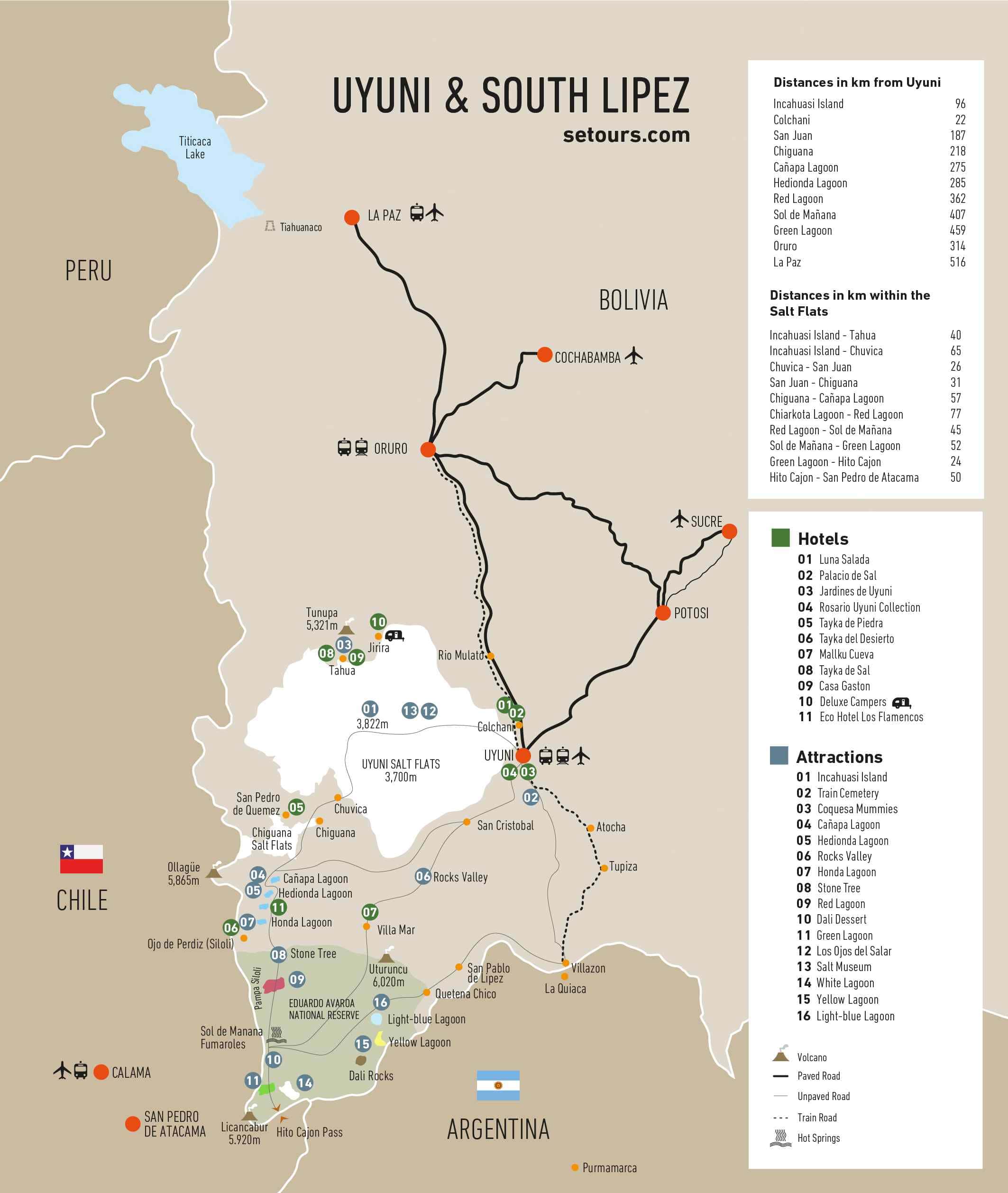
Located at an average altitude of 3,700 meters (12,139 feet), the Uyuni salt flats demand careful consideration of acclimatization. Prior acclimatization becomes vital to ensure a smooth experience. If possible, a preceding stay in Cusco or Puno in Peru, or in San Pedro de Atacama in Chile, will greatly assist in reducing the chances of altitude sickness and enhance your overall well-being during your visit to Uyuni.
The 1-hour La Paz - Uyuni flight is operated by the local carrier BoA. During the rainy months (December - February), availability can be limited due to the high number of Asian travelers visiting to witness the captivating 'mirror effect' on the salt flats.
| BoA | Flight | Monday through Sunday |
|---|---|---|
| LPB-UYU | OB737 | 07:40 - 08:40 |
| UYU-LPB | OB737 | 09:10 - 10:15 |
The bus from La Paz is the cheapest option and covers a distance of around 550km over a period of 9 hours. While this option may be tempting for those who are traveling to Uyuni on a budget, we recommend opting for a trip by plane as you will be spending almost a full day on the bus. While the buses have reclining seats and can be 'comfortable', due to the altitude and time spent in the vehicle, you will arrive at your destination extremely tired and won't be able to truly enjoy the sites.
Trains to Uyuni are rarely used as they require a longer travel time and are not very reliable. Sometimes the heating in the carriages did not function, and when you are at altitude, heating makes a BIG difference to your comfort. This mode of transport is also slightly slower than taking the bus.
You will need to first catch a bus to the Oruro station from La Paz. This is a 4-hour journey, before you can board your train for a further 7-hour trip down to Uyuni. There are two train options on offer:
This is a private service, as there are no tourist/public buses available along this route. You will need to also change vehicles at the Hito Cajon border post to continue your onward journey. This is perhaps the most expensive option, the reason why can be seen below:

The entire trip will be done in a 4x4 vehicle as there are only uneven gravel roads along the way, so be prepared for dust and bumps. Your driver will travel from Uyuni to the border post to collect you as there are no transportation companies in or around Hito Cajon.
Though, the route from Hito Cajon to Uyuni boasts surreal and pristine landscapes untouched by mass tourism. Our tip is to spend a night halfway, at Ojo de Perdiz close to the Siloli Desert. Then, there is enough time to make stops en route when entering from Hito Cajon.
Below are the 'Highlights of the Eduardo Avaroa National Reserve' and our pictures of when we visited the area.


If you're looking at only visiting the highlights in Uyuni, one full day will be perfect. Depending on what you would like to see, selecting the right season/time to go is important. Regardless of the season that you choose to travel there are a number of exciting highlights that are available year-round:


If you have a little more time in your schedule and are looking to explore the salt flats as well as its surrounds, then we recommend a 3-day stay. This will allow you to include some of the awe-inspiring highlights in the Eduardo Avaroa National Reserve, situated south of the Uyuni salt flats (see our map above). The landscapes can be also seen when coming from Chile en-route to Uyuni.


This is the season that is most preferred by photographers (and Instagrammers alike). During the rainy season, the salt pans will flood and create the well-known 'mirror effect'. An illusionary place on earth where the ground and the sky become one.
During this time it is not possible to travel far on the salt pans. Fish Island, with its giant cacti and stunning panoramic views over the endless salt-scape, is unreachable.
Fish Island - This island is home to scores of 8 -12 meter high cacti, some of them over 200 years old. It is a unique destination in the midst of the snow-white salt with 360-degree views over the salt flats.
This is the season preferred by most travelers and where all of the viral videos and pictures with illusionary effects on the dry salt flats are created.


Flights arrive in Uyuni, a small town of approximately 35,000 inhabitants whose population has grown significantly due to tourism. While the town itself lacks charm, it offers budget-friendly accommodation options.
For travelers seeking a more unique experience, two salt hotels are located in Colchani, about 25 minutes by car from Uyuni. Both properties stand alone on the shores of the salt flats, surrounded by the striking landscape. Our map above shows all locations.
Hotel infrastructure in this region has improved significantly in recent years, with two companies already operating 4-star and 5-star properties in La Paz recently investing here as well. Below is a summary of the available options.
Operations during the rainy season remain to be determined, as access to the northern area becomes challenging and full-day excursions to Fish Island are typically unfeasible due to flooded salt flats.
The salt flats are relatively difficult to get to and it is not as simple as catching a flight directly there and visiting the site.
Distances covered in the area are long and there are no highways connecting anything, only bumpy gravel roads and trails that experienced drivers are trained to recognize can be used.
Tours can be only done with 4x4 and costs are not able to be split among a larger number of passengers as it is with regular tours in larger cities. Everything you need during your trip as supplies for your picnic lunch, water, gas, etc, is packed on the vehicle as you can see in our picture below.

The harsh conditions of Uyuni can be particularly challenging for vehicles, as the salt can cause damage and increase the running costs.
Uyuni, being a small town, lacks extensive infrastructure. Finding guides proficient in languages such as German or French can be challenging. In most cases, these guides need to travel from La Paz and are only available for prearranged trips.
Hotels apply higher rates during the rainy season, so visiting during the dry season is more economical. Each jeep accommodates up to three passengers plus one guide, with per-person costs decreasing significantly when traveling as a group of three versus two.
For budget-conscious travelers with basic Spanish skills, tours with Spanish-speaking drivers only and audio guides offer additional savings.